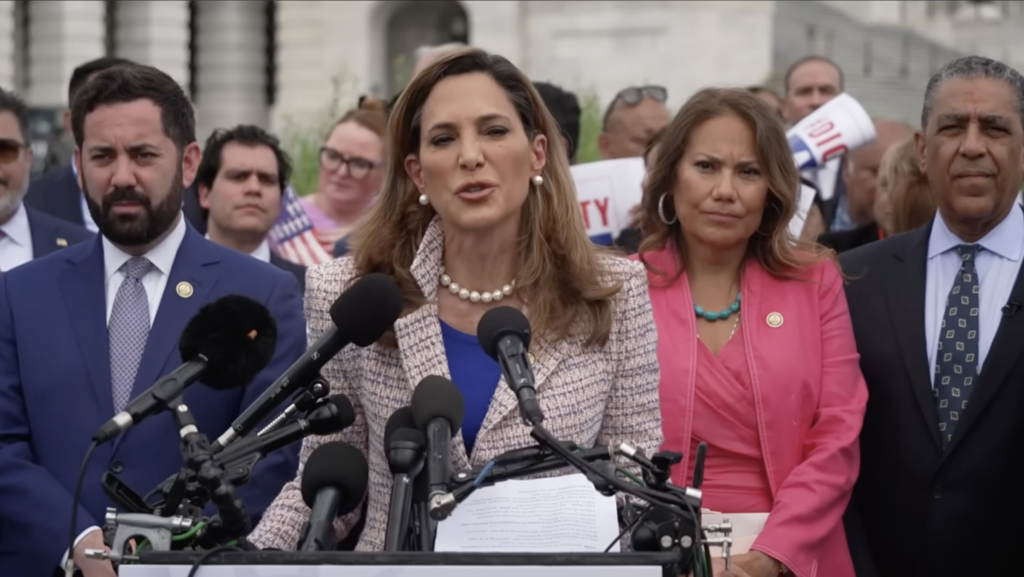
Despite President Donald Trump winning on the promise of “mass deportations,” a handful of spineless Republicans, alongside Democrats, are trying to push a mass amnesty act known as the DIGNIDAD Act — or, for English speakers, the DIGNITY Act.
The legislation is billed as not being amnesty, but would give millions of illegal aliens — both so-called DREAMers/DACA and non-DREAMers/DACA — a legal status. But co-sponsor Rep. Maria Elvira Salazar, R-Fla., insists it’s not amnesty, so much so that she’s screaming at people on X to “READ. THE. BILL. BEFORE. YOU. OPEN. YOUR. MOUTH.”
Student Loan Forgiveness For Lawyers Who Provide Legal Services To Illegals
According to a “Section-by-Section Analysis” of the DIGNITY Act by Salazar and Veronica Escobar, D-Texas, the legislation creates a special loan forgiveness program for lawyers who provide legal services to illegal aliens at “Humanitarian Campuses.” “Humanitarian campuses” would be new facilities where illegal aliens get processed. Lawyers who complete four years of full-time service get 75% of their outstanding law school loans forgiven.
In other words, Americans will have to pay for lawyers to keep illegal aliens here.
Importation Of Illegal Aliens Who Had Already Been Deported
The legislation also opens the door for aliens who were previously deported to come back to the United States and seek relief if they would otherwise qualify under the legislation.
“With respect to aliens who were removed or departed the United States on or after January 20, 2017, and who were continuously physically present in the United States for at least 5 years prior to such removal or departure, the Secretary may, as a matter of discretion, waive the physical presence requirement under section 2102 (b)(1)(A) or section 2302(1)(A) for humanitarian purposes, for family unity, or because a waiver is otherwise in the public interest.”
The section also stipulates the secretary of state should create a procedure for aliens to apply for the “relief” even if they had been deported but would otherwise have been eligible.
Exemptions From FICA Taxes
Aliens would be exempt from Social Security/Medicare payroll taxes but have to pay a 1 percent levy on adjusted gross income, according to Salazar and Escobar’s analysis.
“Dignity participants will be exempt from paying FICA taxes. However, they will be charged a separate 1% levy on their adjusted gross income,” the legislation reads.
The exemption from standard payroll taxes shifts the tax burden away from aliens while they receive work authorization and protection from removal.
Halts Deportations
The DIGNIDAD Act also includes protections that prevent aliens from being removed while their applications are pending. Under the legislation, aliens applying under the Dream provision can be given an opportunity to file even if removal proceedings have started, and those denied a change of status can seek judicial review without being subject to removal. According to the analysis, “Aliens that receive a denial of application for adjustment may apply for judicial review. Aliens seeking judicial review are exempt from removal proceedings during the review.” The analysis also states that the Dignity Program provides, among other things, “protection from removal proceedings, if conditions are being met.”
Further, the legislation is not merely for so-called Dreamers or DACA recipients, that is, aliens allegedly brought here as children. Under the legislation, there is a separate track for illegal aliens who do not qualify as DREAMers or DACA recipients. Section 2302 states the secretary of homeland security can register illegal aliens for the program if the alien “has been continually physically present in the United States since December 31, 2020,” pays a $1,000 fine, passes a background check, provides biometric data, and isn’t disqualified by any other section.
Such a provision, combined with a prohibition on deportations with paperwork pending, would effectively end mass deportations.
Grants Permanent Residency
The DIGNIDAD Act also includes a loophole that basically hands aliens a green card. So long as an alien has entered the country before turning 18 and has been here continuously since January 1, 2021, the alien is eligible for green card status. After meeting basic education, work or military requirements and passing a background check check, the alien can get a green card status which could eventually lead to citizenship if they want to seek it.
AG Can Stop Deportation For Family ‘Hardship’
The attorney general is given broad discretion to terminate deportation proceedings for family “hardship” reasons. This means the attorney general can stop removal cases when an illegal alien claims extreme hardship to a lawful permanent resident spouse, parent, or child.
Wipes 3/10 Year Bans
Illegal aliens who are in the country illegally for more than 180 days but less than a year are currently subject to a three-year re-entry ban, according to Section 212 (a)(9)(B) of the Immigration and Nationality Act. Illegals here for more than a year are subject to 10-year bans. But the DIGNITY Act lets the Secretary of Homeland Security waive those bans for eligible participants of the DIGNITY Program so long as they meet the other requirements.
Illegals With DUI Or DWI Convictions Can Stay
During an interview with Fox News’ Laura Ingraham, Rep. Mike Lawler, R-NY, who is co-sponsoring the bill seemingly had no idea that it allows for illegal aliens convicted of DUI and DWI’s to stay in the country.
“That should be included [for deportation],” Lawler agreed.
“It’s not!” Ingraham explained to him. “They can stay under this legislation!”
Under the legislation, an alien with a misdemeanor DUI or DWI conviction would still be eligible to participate in the DIGNITY program. Section 2302 Eligibility, subsection (3), states an “alien is ineligible for participation in the Dignity Program if, excluding any offense under State law for which an essential element is the alien’s immigration status, and any minor traffic offense, the alien has been convicted of any felony offense, two or more misdemeanor offenses, a misdemeanor offense of domestic violence…”
The legislation specifically carves out “minor traffic offense” from convictions that could impede eligibility. While DUI/DWI are not always classified as a minor traffic violation, first offenses are typically misdemeanors in most states. The legislation states that “two or more” misdemeanor offenses can make someone ineligible for the Dignity program. Therefore, an alien convicted of one DUI/DWI may still be eligible.